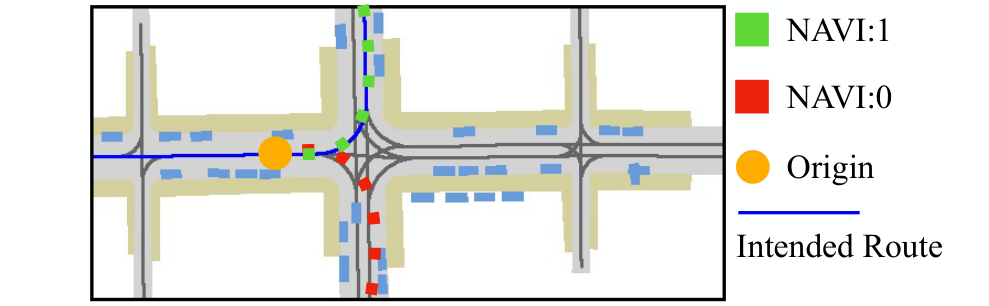
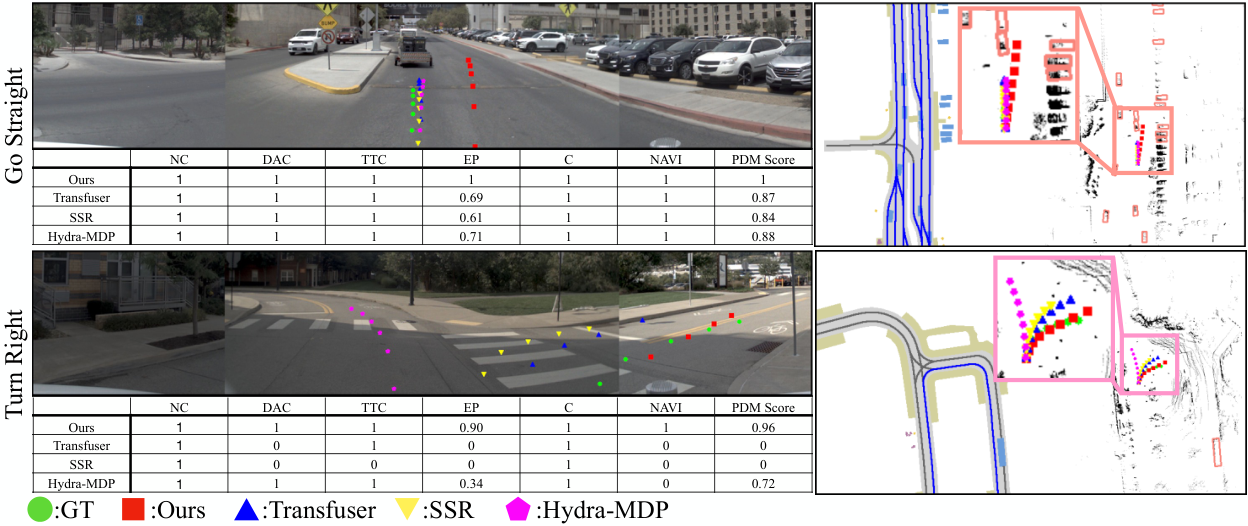
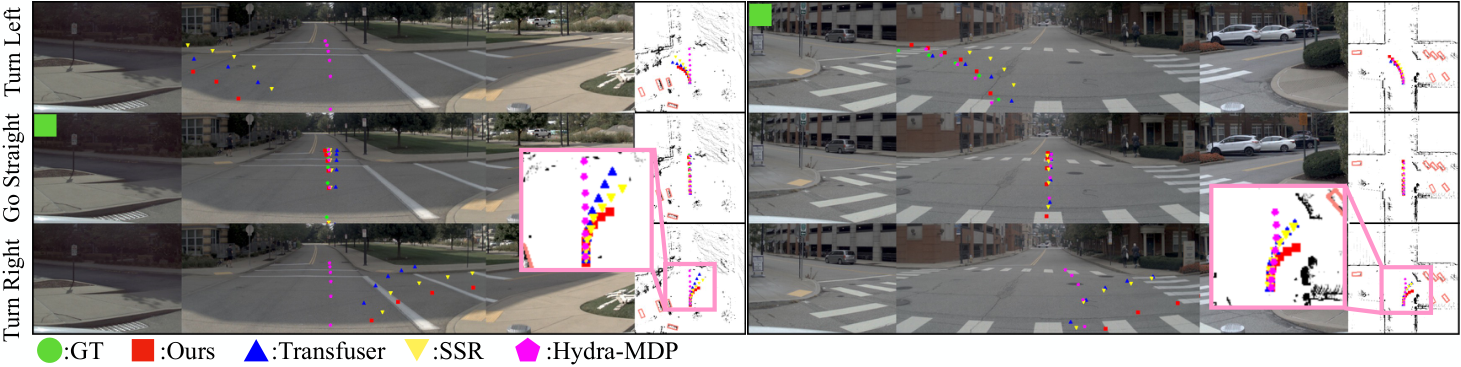
Trajectory-scoring planners achieve high navigation compliance when following the expert's original command, yet they struggle at intersections when presented with alternative commands—over 30% of such commands are ignored. We attribute this navigation compliance gap to two root causes: (1) existing metrics like Ego Progress do not explicitly measure navigation adherence, diluting the gap between on-route and off-route trajectories; and (2) current datasets pair each scenario with a single command, preventing models from learning command-dependent behavior.
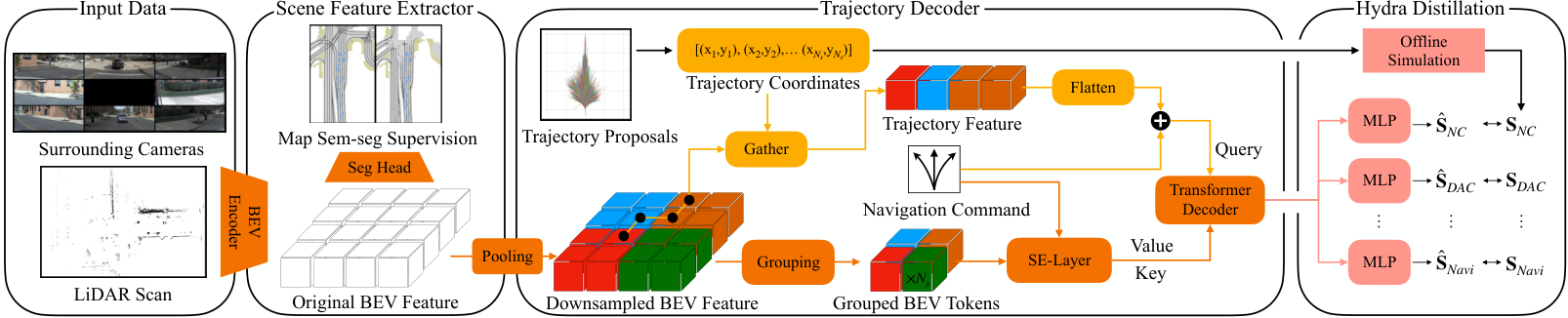
We address the metric gap by introducing the binary Navigation Compliance metric (NAVI) and the derived Controllability Measure (CM), and the data gap with the NavControl dataset—14,918 intersection scenarios augmented with all feasible alternative commands and routing annotations, yielding over 34,000 direction samples. Building on these, we propose NaviHydra, a trajectory-scoring planner incorporating NAVI distillation and Bird's Eye View (BEV)-based trajectory gathering for context-position-aware trajectory feature extraction. NaviHydra achieves 92.7 PDM score on the NAVSIM navtest split and 77.5 CM on the NavControl test split. Training with NavControl improves controllability across diverse architectures, confirming it as a broadly effective augmentation for navigation compliance.
Quantitative comparison on the navtest split of the NAVSIM benchmark. †: retrained on navtrain. *: evaluated using official checkpoint. ‡: retrained with our V4096 trajectory proposals.
| Method | Inputs | NC↑ | DAC↑ | EP↑ | TTC↑ | C↑ | PDM Score↑ |
|---|---|---|---|---|---|---|---|
| PDM-Closed | Perception GT | 94.6 | 99.8 | 89.9 | 86.9 | 99.9 | 89.1 |
| SSR† | Camera | 93.7 | 86.3 | 70.0 | 86.5 | 98.1 | 73.6 |
| Transfuser* | LiDAR & Camera | 97.8 | 92.1 | 78.6 | 92.8 | 100 | 83.4 |
| UniAD | Camera | 97.8 | 91.9 | 78.8 | 92.9 | 100 | 83.4 |
| PARA-Drive | Camera | 97.9 | 92.4 | 79.3 | 93.0 | 99.8 | 84.0 |
| Hydra-MDP-V4096‡ | Camera | 98.3 | 97.3 | 84.3 | 93.4 | 100 | 89.0 |
| Hydra-MDP++ V8192 | Camera | 98.6 | 98.6 | 85.7 | 95.1 | 100 | 91.0 |
| Hydra-MDP-V16384* | Camera | 98.5 | 98.8 | 85.4 | 94.9 | 100 | 90.8 |
| NaviHydra-V4096 (Ours) | Camera | 98.4 | 97.2 | 84.0 | 95.1 | 99.5 | 89.3 |
| NaviHydra-V4096 (Ours) | LiDAR & Camera | 98.7 | 98.6 | 88.7 | 96.2 | 100 | 92.7 |
Controllability evaluation on the NavControl test split. †: retrained on navtrain. *: official checkpoint. ‡: retrained with our V4096 trajectory proposals. §: trained with additional NavControl intersection scenarios. CM = NAVI × PDM.
| Method | Inputs | NC↑ | DAC↑ | EP↑ | TTC↑ | C↑ | NAVI↑ | PDM↑ | CM↑ |
|---|---|---|---|---|---|---|---|---|---|
| SSR† | Camera | 91.3 | 80.6 | 67.7 | 83.3 | 95.4 | 62.8 | 68.8 | 49.9 |
| Transfuser* | LiDAR & Camera | 96.7 | 91.7 | 80.6 | 91.6 | 99.8 | 67.5 | 83.4 | 59.4 |
| Hydra-MDP-V4096‡ | Camera | 98.0 | 97.4 | 88.4 | 95.0 | 100 | 69.6 | 91.4 | 63.8 |
| NaviHydra-V4096 (Ours) | Camera | 98.4 | 97.8 | 87.1 | 96.0 | 99.2 | 73.9 | 91.4 | 67.6 |
| SSR§ | Camera | 86.8 | 78.9 | 64.0 | 77.5 | 80.9 | 70.2 | 61.8 | 48.6 |
| Transfuser§ | LiDAR & Camera | 88.8 | 88.2 | 73.1 | 81.3 | 89.9 | 81.5 | 72.6 | 62.6 |
| Hydra-MDP-V4096ठ| Camera | 95.8 | 97.2 | 87.7 | 90.3 | 98.2 | 74.8 | 88.3 | 66.5 |
| NaviHydra-V4096§ (Ours) | Camera | 97.2 | 97.4 | 83.2 | 94.3 | 96.4 | 87.6 | 88.0 | 77.5 |
Augmenting training with NavControl intersection scenarios (§) consistently improves NAVI across all methods. NaviHydra§ benefits the most (+9.9 CM), demonstrating that our framework is specifically designed to exploit the contrastive intersection-level signal.
@inproceedings{wu2026closing,
  title     = {Closing the Navigation Compliance Gap in End-to-end Autonomous Driving},
  author    = {Wu, Hanfeng and Steiner, Marlon and Schmidt, Michael and Marcos-Ramiro, Alvaro and Stiller, Christoph},
  booktitle = {IEEE/RSJ International Conference on Intelligent Robots and Systems (IROS)},
  year      = {2026}
}